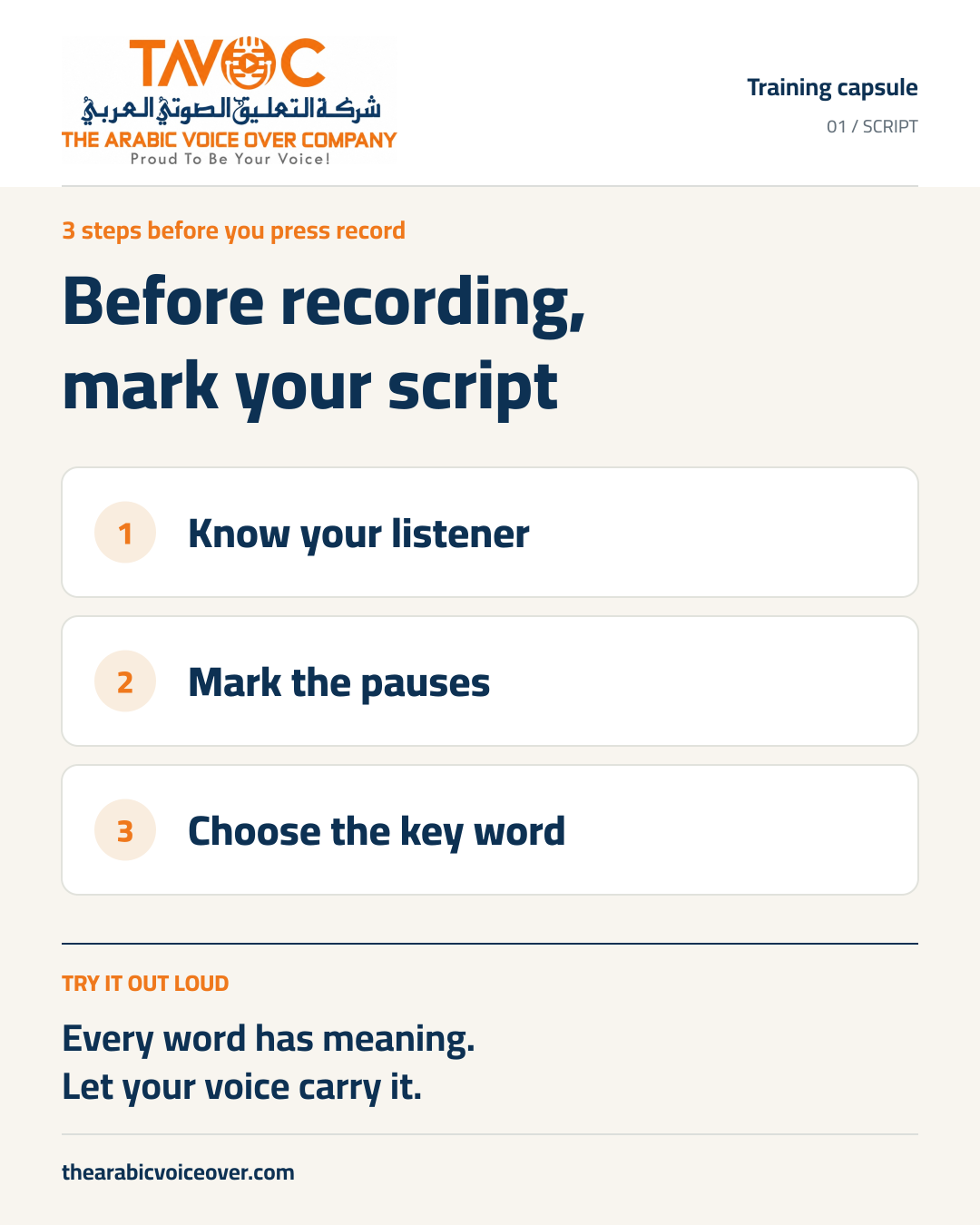
You can pronounce every word correctly and still leave a listener unsure what matters. Before you record a voice-over, try marking the script for meaning: where an idea finishes, which word carries the contrast, and when the listener needs a moment. A few readable notes can give your next take a clear purpose.
This beginner workflow uses an original practice script and a simple recording comparison. The marks are working choices, not a universal notation system. Keep the approved words intact, and change your delivery notes when listening reveals a better option.
Start with the message, not the marker
Write three answers above the script: who is listening, what they need to understand, and what they should do next. Be specific. “A first-time visitor finding the entrance” is more useful than “everyone.” For a short museum guide, the next action might be entering a room; for a tutorial, it might be selecting a menu item.
Now explain the message in one sentence without reading. If you cannot do that, resolve the uncertainty before adding performance notes. Check unclear names, numbers and instructions with the person responsible for the text. A confident delivery should not conceal a guess.
Read once before adding symbols
Make an unmarked read at a comfortable pace. Notice where the wording catches you or an idea feels unfinished. In BBC Academy’s “Presenting: Finding your voice” session, the coach asks participants to test writing aloud; the discussion also covers pause reminders and underlined emphasis. Use that first read to discover your needs rather than decorating the page in advance.
If this is your own practice copy, you can revise a difficult sentence. With an approved client script, flag a proposed change separately and get it cleared. Your performance copy should not quietly become a different message.
Give each mark one job
For this exercise, use only four cues:
- / means a short pause between connected ideas.
- // means a more noticeable pause at a transition.
- Bold text marks a word or phrase you want the listener to notice.
- A note in square brackets describes your intention, such as [welcome] or [explain].
These are suggestions for this page, not fixed studio rules. Write the key at the top if another person will use your copy. The University of Washington’s guidance on preparing a manuscript for the ear recommends clear phrase spacing and selective emphasis marks, while acknowledging personal notation preferences.
Choose emphasis by asking a question
Try the sentence “The blue folder contains the final version.” What question are you answering? If someone asks which folder, “blue” carries the useful contrast. If they ask whether the draft is finished, “final” deserves attention. Marking both automatically may blur your intention.
For your first attempt, choose one main focus in each short thought. This is an exercise constraint, not a rule for every sentence. Try giving that word slightly more time, then try a small change in pitch. Listen for the version that communicates your answer without making the word sound detached from its neighbours.
Put pauses where they preserve the thought
A comma is useful information, but it does not prescribe an identical silence every time. In “Choose the blue folder / then open the final version,” the pause separates two actions. A pause after “the” would interrupt the folder description. Test the complete phrase, not just the punctuation.
Leave room for the pause within the required recording length. If the read does not fit, ask whether the wording or timing can change instead of simply racing through the ending. Do not assign every slash a fixed number of seconds; test it against the listener’s task.
Practise with a short visitor announcement
This fictional script is original practice material, not a real event announcement:
[welcome] Welcome to the neighbourhood story room. / Choose one object from the table and imagine who owned it. // [explain] You do not need a long story. / Start with one detail: a colour, a sound, or a place. // [invite] When you are ready, / share your first sentence.
The pauses separate the welcome, explanation and invitation. “One object” and “one detail” suggest manageable starting points. Another valid reading might foreground “imagine” and “share.” Decide which message you want this listener to receive before choosing between them.
Compare two takes and keep one useful change
- Record the unmarked script once and label it Take A.
- Add your cues and record Take B using the same recording setup.
- Listen without looking at the page. Can you identify the next action?
- Compare one passage: did your pause clarify the instruction or split it awkwardly?
- Remove any mark you followed mechanically. Record that passage again.
Keep the version that makes the intended meaning easier to follow, not automatically the louder or more dramatic take. Save the marked page with one sentence explaining your best change. For more voice-over reading, visit the TAVOC blog. To discuss a recording brief or ask about current training information, use TAVOC’s contact page.