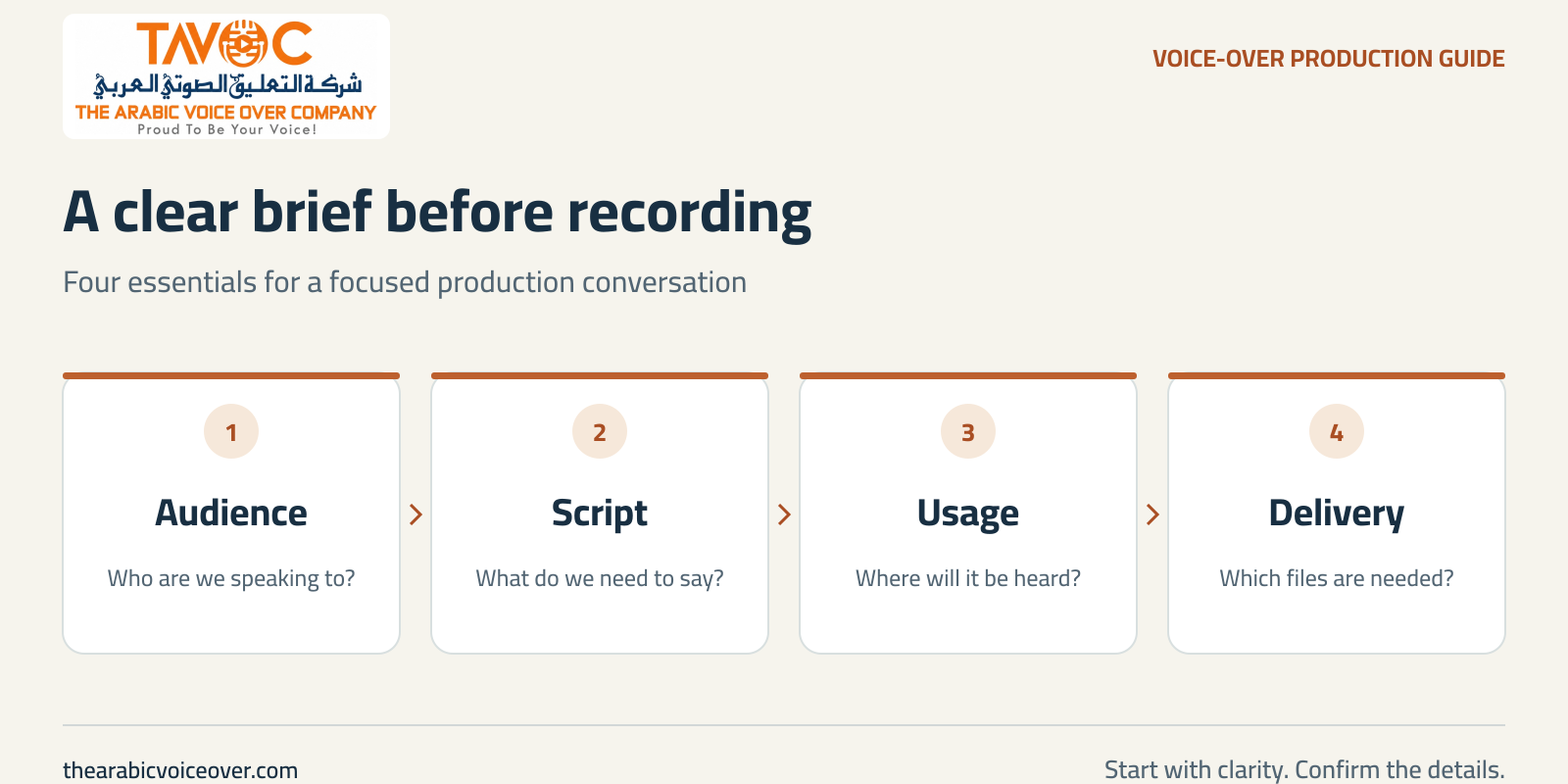
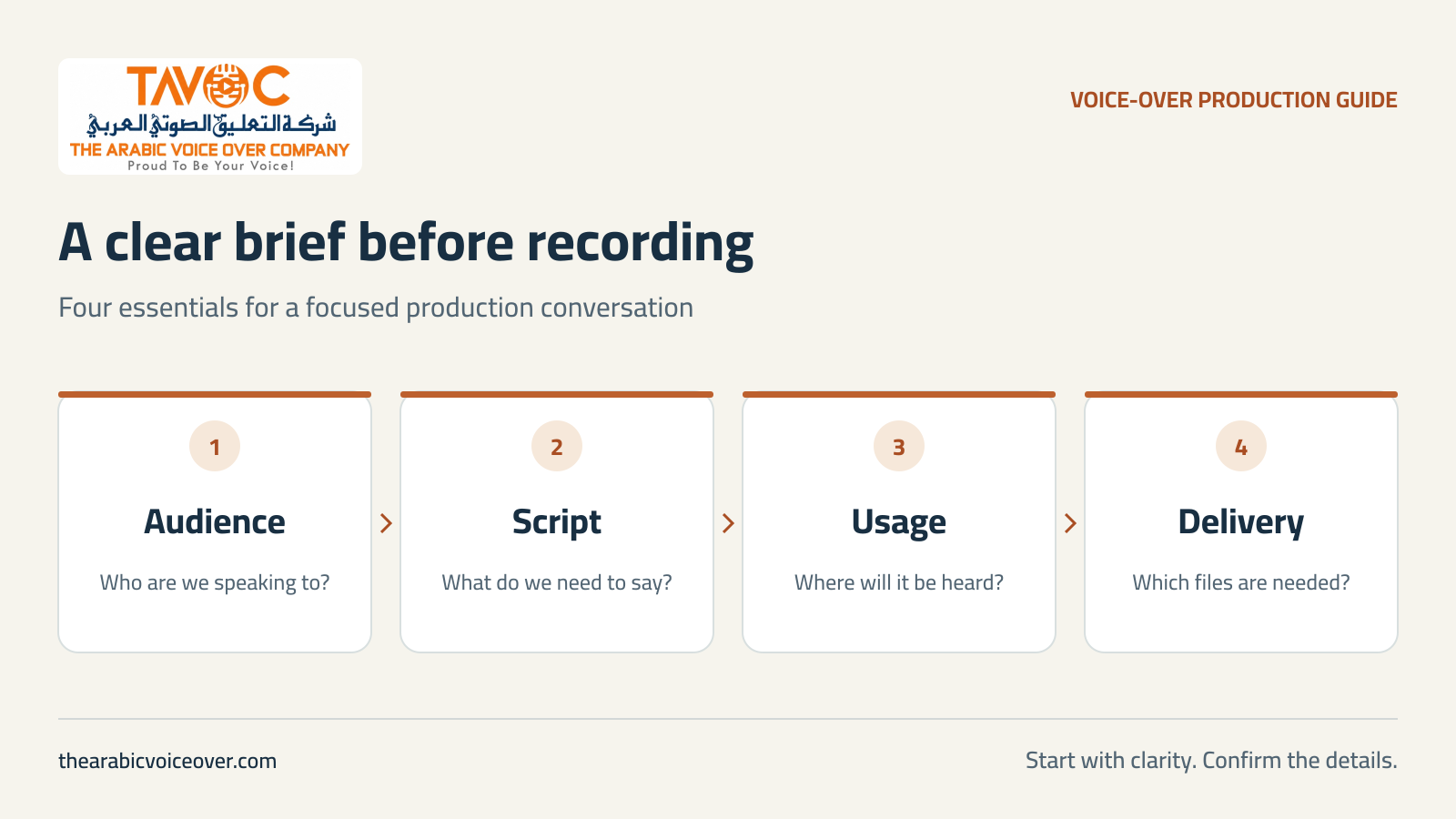
“We need a professional voice-over for our company video” describes a task, but leaves the production team with several different possible projects. A business voice-over brief turns that opening request into a shared description of the audience, message, script, intended use and delivery requirements.
You do not need a long presentation to begin. You need clear decisions and visible gaps. This practical checklist is for project owners preparing a recording and new voice actors learning to interpret a client’s instructions. A completed brief is not, by itself, a booking confirmation, quotation or delivery commitment.
Start with the listener, not an impressive adjective
Describe who will hear the recording and what they need to understand. A first-time customer learning to use an app has a different starting point from an employee reviewing a familiar process. Keep the description relevant to the communication rather than making assumptions about the listener.
Then state the intended next step. “Explain the first three steps and direct the viewer to our help page” is more useful than “make the video engaging.” The team can use the former to discuss whether the script and delivery support the message. It does not promise a particular sales result.
Make the script’s status unmistakable
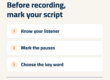
Attach a clearly named version and identify whether it is approved or still being edited. Separate spoken lines from on-screen wording and production notes. If the final line is awaiting approval, label that line rather than allowing everyone to assume that the entire script is ready.
Voices’ scriptwriting guidance recommends reading copy aloud and clarifying difficult pronunciations. In your own brief, list product names, abbreviations and specialist terms that require a reference. A short pronunciation recording can be more useful than a note that simply says “use the correct pronunciation.”
Specify the language and explain the performance
For Arabic voice-over, clarify whether the project calls for Modern Standard Arabic or a particular dialect. Mark how foreign brand names should be spoken. For multilingual production, identify the approval status and reviewer for each language version; one approved source script does not establish approval of every translation.
Describe the speaker’s relationship with the listener. “A calm guide explaining an unfamiliar process” gives a clearer direction than “a powerful voice.” When sharing a reference, name the characteristic you want to discuss, such as measured pacing or a welcoming delivery. Use references to communicate an approach, not to request an imitation of a real person’s vocal identity.
Separate timing from the delivery deadline
Write down the target running time and identify any fixed timing points. If the voice must follow an existing edit, supply the relevant version and explain which moments need synchronisation. If the picture is still changing, say so. A provisional edit should not look like an approved timing reference.
Record the requested deadline with its time zone, along with your availability to review a take. These are planning inputs until the production team confirms the schedule. If the script does not comfortably fit the intended space, discuss authorised cuts or a revised duration rather than assuming that a faster read will solve the problem.
Define the intended use
List where the recording is intended to appear, the requested usage period and territory. Distinguish a company website from paid advertising or internal training. Voice123’s project guide likewise includes recording purpose, paid media and usage duration in its project information. Your brief gives the team the details to discuss; the agreed project terms determine the actual scope.
Describe the files and the approval process
Ask the person handling the final edit to confirm file format, whether separate clips are required, and naming conventions. If you do not know a specification, mark it as unresolved. Choosing an arbitrary setting can create a mismatch between what is delivered and what the next person needs.
Nominate a contact to combine feedback into one clear response. “Please match the pronunciation of the product name in the supplied recording” is actionable. “Something is missing” needs a follow-up question. Keep a pronunciation correction distinct from a rewritten sentence or a new performance direction so that the team can review each change properly.
A short exercise for new voice actors
Read this fictional brief and identify the questions you would ask before recording:
- Audience and goal: first-time users need a clear explanation of a new service.
- Script: Arabic draft version two; the product name has no pronunciation reference yet.
- Delivery: friendly and clear, with room to follow each step.
- Picture: a one-minute target; the edit is not approved.
- Use: a service information page; any additional advertising use is unresolved.
- Open items: final format, review contact and delivery date.
Do not quietly fill in those gaps yourself. Choose the three questions that would most affect your preparation, write them plainly, and explain which decision each answer will unlock. This exercise develops your ability to work from a brief, not just read the words on a page. Explore more practice topics in the TAVOC article section.
Prepare your next voice-over enquiry
The Arabic Voice Over Company provides voice-over services for projects including advertising and educational content. Send your project outline and script, or its current status, to [email protected], or use the contact page to discuss the language, intended use and delivery requirements. Keep unnecessary personal, customer and confidential information out of the brief.